Retro Games are often sold as sealed containers of childhood: insert cartridge, receive memory. That description is too small for what many of us actually remember. The PS2, original Xbox, and GameCube era was not simply a collection of older hardware. It was a period when developers worked within visible limits, and those limits produced pauses, awkward interfaces, compressed sound, and spaces that felt strangely private. I return to Retro Games now not to recover a vanished version of myself, but to understand why certain rooms still remain in my head after more polished experiences have disappeared.
For adults with less free time, this distinction matters. A game can be historically important and still be a poor use of an evening. The point is not to praise every old release or treat inconvenience as sacred. It is to identify which friction created meaning, which systems were merely unfinished, and which remasters have confused brightness with improvement.
The hardware limits were part of the language
Sixth-generation consoles had different ways of hiding and revealing their boundaries. The PS2 often used narrow corridors, heavy fog, and restrained texture detail to manage memory. The GameCube could produce remarkably clean color and geometry, but its small optical discs influenced how games handled scale and storage. The original Xbox had more room for textures and audio, yet its hard drive and controller layout encouraged a different rhythm of loading and saving.
These were not just technical footnotes. They shaped what players felt. A foggy street in Silent Hill 2 is not merely an incomplete view distance; it is a form of withheld information. A long elevator ride in Metal Gear Solid 2 or a quiet transit sequence in another adventure can become a pressure valve between scenes. Modern design often removes such intervals because they appear inefficient. Sometimes that is sensible. Sometimes the interval was where the game became human.
Retro Games also had a physical presence that digital libraries tend to flatten. A memory card could be misplaced. A disc could gather fingerprints. The boot screen, the hum of a console fan, and the small ritual of selecting a save file established a threshold. None of this automatically makes an old game good, but it explains why returning to one can feel less like opening software and more like entering a room that has been waiting without you.

Forgotten games deserve more careful attention
The obvious classics have already received their monuments. The more interesting work often sits beside them: mid-budget games that had one excellent idea, a peculiar mood, or a failure too specific to become a franchise. Consider titles such as The Mark of Kri, Gregory Horror Show, Shadow of Memories, or Metal Arms: Glitch in the System. Their rough edges are visible, but so is the evidence of teams trying to solve problems without a dependable commercial template.
This is where Retro Games become useful historical objects rather than nostalgia props. A game that sold modestly may reveal how publishers once tolerated strange pacing, unusual protagonists, or mechanics that would now be assigned to a smaller download title. Some of these experiments are frustrating. Others offer a kind of creative loneliness that large modern productions rarely risk.
When choosing what to play, I use a simple test. Does the game have a strong central mood? Does its control scheme express that mood rather than interrupt it? Are its problems structural, or can patience and a sensible display setup solve them? A title with dated textures can remain absorbing if its environments communicate clearly. A visually impressive release can feel empty if every room exists only to move the player toward the next objective.
Remasters improve the image, not always the memory
A remaster can be the best way to revisit an old favorite, but the label describes preservation only loosely. Texture replacement, new lighting, widescreen support, higher frame rates, and improved audio can make a game easier to read. They can also alter its emotional temperature. A darker hallway becomes neutral gray. A harsh bloom effect disappears. An enemy silhouette that once emerged from visual noise becomes perfectly legible and therefore less frightening.
Higher resolution is not the same thing as higher memory. The original signal included limitations: aliasing, loading pauses, low-detail faces, and sound that seemed to come from somewhere just beyond the room. When an upgrade removes all of those qualities, it can become cleaner and less alive at the same time.
The best Retro Games remasters understand restraint. Shadow of the Colossus on PlayStation 4 is technically impressive, yet its revised visual language invites debate because atmosphere depends on more than polygon count. The Resident Evil 4 remake is a substantial reimagining rather than a neutral restoration, and its changes work best when judged as design decisions. Meanwhile, an emulated original with a sensible resolution scale may preserve the particular ugliness that made a scene memorable.
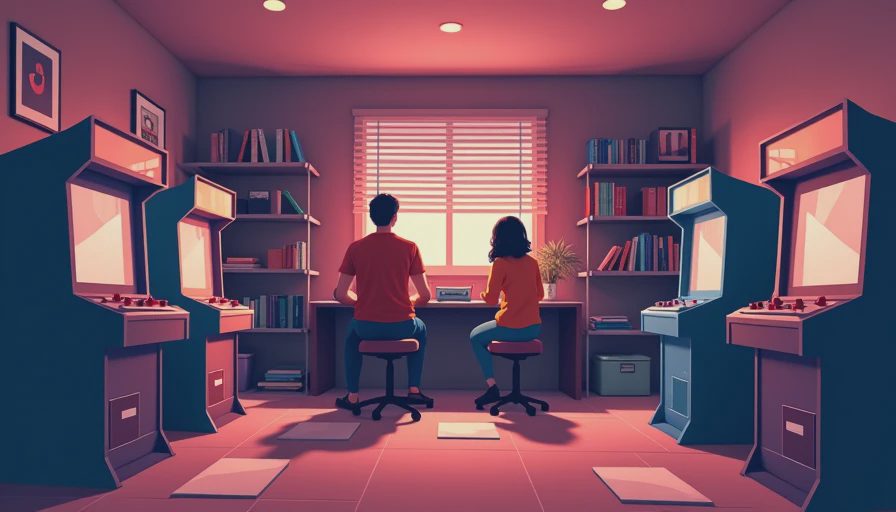
How to compare an original with a remaster
Start with the same scene in both versions, preferably one that includes exploration, combat, and a quiet transition. Do not begin with a screenshot comparison. Play for twenty minutes without pausing and notice where your attention goes. Is the room easier to understand, or merely brighter? Does the new frame rate improve control without making animation feel weightless? Has the music been remixed in a way that changes distance, echo, or silence?
Next, compare the interface. Menus, subtitles, map icons, button prompts, and save screens are not decoration. They determine how much mental effort remains for the fiction. A redesigned map can eliminate confusion, but it can also remove the need to remember a place. A faster inventory can respect limited time while quietly changing resource tension. Quality-of-life improvements are never neutral when the original system was built around delay.
Finally, return to the original for one complete chapter or location. This prevents the new version from becoming the default simply because it is more comfortable. I keep notes on color, camera behavior, audio balance, loading, enemy reactions, and the feeling of walking through empty space. Technical differences matter most when they explain an emotional difference.
Making time for old games now
The adult return to Retro Games requires a smaller commitment than the complete-playthrough culture suggests. Choose one chapter, one neighborhood, or one system to study. Set up a comfortable display, but avoid turning every imperfection into a repair project. A $30 to $60 compatible controller, a clean HDMI adapter, and a proper save backup can matter more than an expensive upscale device. The goal is to remove preventable irritation while preserving the character of the software.
Emulation can be useful for legally owned games and systems that are difficult to connect to modern displays. Original hardware has its own pleasures, especially when the controller, memory card, and boot sequence form part of the ritual. Neither approach is morally or emotionally superior by default. What matters is whether the method lets you notice the game instead of spending the evening fighting cables, input lag, or a broken save battery.
Retro Games reward selective attention. You do not need to finish every title, own every console, or defend every awkward mechanic. Spend an hour with the strange game your friends ignored. Compare one hallway before and after a remaster. Listen to the room tone when nothing is happening. That is often where the older design period speaks most clearly.
What remains after the nostalgia fades
The strongest Retro Games do not survive because they perfectly reproduce the past. They survive because their constraints gave them a distinct shape. Their interfaces asked us to remember. Their empty spaces made us wait. Their imperfect faces left room for interpretation. Even their technical compromises could create distance, uncertainty, or tenderness that a more capable machine might accidentally erase.
That does not mean older is automatically better. Some controls deserve replacement, some camera systems deserve mercy, and some loading screens deserve to remain in history. But criticism should be precise. Ask what a change solves, what it removes, and whether the loss was carrying more emotional weight than anyone noticed at the time.
The useful question is not whether a game looks old. It is whether its oldness still has something to say. For me, the answer is often found in the quiet after a door opens, before the next objective appears. The screen is rough, the room is underlit, and the past does not look beautiful. It looks present. That is why Retro Games continue to matter.





No notes yet — write the first one.