League of Legends is often discussed as an esport, a social ritual, or an argument that escaped the internet and learned to walk. I am more interested in the game underneath those labels: the patient map, the layered interface, and the particular fatigue produced by making one bad decision twenty minutes before the match ends. For adults who remember the PS2 and original Xbox era, its importance is not nostalgia. It is endurance. This is a game that has remained recognizable while repeatedly rebuilding its own machinery.
A game designed around incomplete knowledge
The first thing League of Legends asks from a player is not speed. It asks for uncertainty. The minimap is never the whole map. An opponent disappears into fog, and the missing information becomes an active force. You are not simply controlling a champion; you are estimating what another person might do with information you do not possess.
That structure gives ordinary movement unusual weight. Walking toward a lane can be safe, reckless, or strategically correct depending on a ward, a cooldown, or a teammate who has stopped answering. The rules are visible, but their consequences are distributed across five players and several minutes. This is why a match can feel mathematically legible while still producing the old familiar sensation of being lost in a dark room.
League of Legends also turns repetition into education. The second time a champion catches you with the same ability, the mistake is yours in a way that feels almost physically measurable. The game stores your errors without sentiment. It does not care that you had a long day, that your coffee went cold, or that you only had one match available before work in the morning.
That indifference can be cruel. It can also be clarifying. Many older games were built around limited lives, fixed checkpoints, and the knowledge that failure would cost time. League of Legends replaces those limits with information. The price of losing is not a quarter or a save-file restart, but a sharper understanding of distance, timing, and attention.
Why the map still carries atmosphere
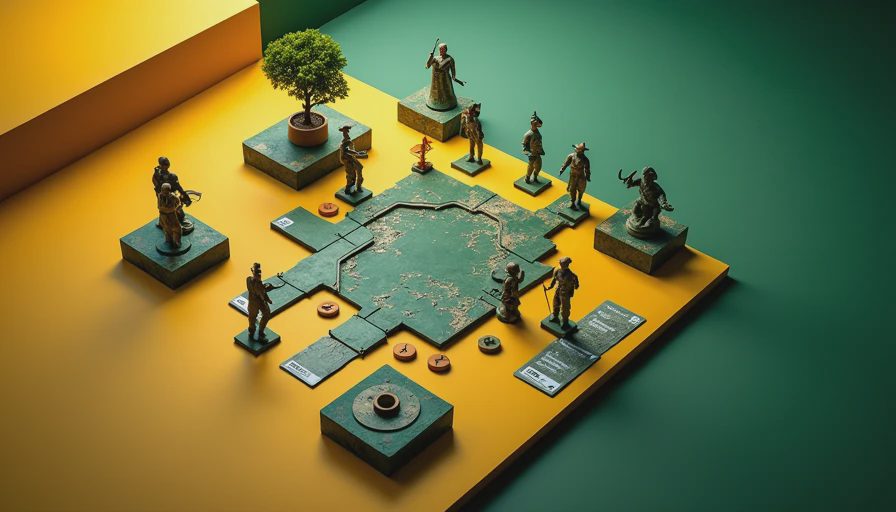
Summoner's Rift is not an atmospheric space in the conventional survival-horror sense. It does not ask you to admire a ruined hallway or listen for footsteps behind a locked door. Its atmosphere comes from anticipation. Grass conceals intentions. A river crossing becomes dangerous because it connects separate forms of knowledge. The lanes look open, yet every open stretch contains possible pressure.
This is where League of Legends differs from many polished modern multiplayer games. The map is not merely a stage for action. It is a readable argument about territory. Towers establish threat, jungle routes create ambiguity, and objectives force players to reveal what they would rather hide. Even the simplest walk from base to lane has a rhythm: preparation, exposure, contact, retreat.
The visual language has changed over the years, but the underlying arrangement remains unusually durable. Cleaner effects and brighter character models can improve clarity, especially during chaotic fights. They can also flatten the quiet spaces between fights. A game can become cleaner and less alive at the same time. Higher resolution is not the same thing as higher memory.
For someone returning after years away, the hardest adjustment is not learning a new champion. It is relearning the map as a social instrument. Every location has a reputation built from countless previous matches. The river is not dangerous because the pixels say so. It is dangerous because players have agreed, over time, to make it dangerous.
The strange economics of a match
League of Legends is built from small advantages that accumulate until they become emotional weather. Ten extra minions, a level lead, an earlier item, or a recalled opponent can change the next five minutes. None of these events looks decisive in isolation. Together, they alter which fights are available and which are fantasies.
This creates a rare kind of drama. The most important moment may not be the dramatic team fight that ends the game. It may be the decision to leave lane with enough gold for a key component, or the restraint to avoid chasing an enemy into fog. The game rewards visible courage, but it often rewards invisible refusal more heavily.
The item system gives League of Legends its peculiar vocabulary. Players speak in purchases because purchases are compressed theories of the match. A defensive item says the opponent's damage matters. A mobility choice says positioning is the problem. A damage spike says the player believes time is running out. These decisions are practical, but they also reveal how each player interprets the battlefield.
That interpretive layer is why casual matches can still become memorable. You remember the match where a modest adjustment solved a problem that seemed personal. You remember discovering that the enemy was not unbeatable; your first approach was simply wrong. The game turns self-knowledge into a build path, which is both elegant and slightly alarming.

Playing when your free time has changed
The modern adult player often has an uncomfortable relationship with League of Legends. A match can fit into an evening, but the emotional aftermath can stretch beyond it. A win may feel unfinished because the next game is available immediately. A loss can occupy the drive home, the shower, or the five quiet minutes before sleep.
The practical answer is not to pretend the game is relaxing. It is to give each session a boundary. Decide whether you have time for one serious match or only a short mode such as ARAM. Disable the idea that every queue must become a learning project. If you are exhausted, play for one narrow purpose: last-hitting, warding, or practicing a champion's spacing. A limited goal turns a sprawling system into a manageable evening.
League of Legends becomes more interesting when it is treated as a place to visit rather than a machine that must be conquered. That distinction matters for players in their thirties and forties, whose attention is no longer an infinite resource. You do not need to prove permanent mastery. You need to notice what the game is asking today.
What remains after the noise
The public image of League of Legends is louder than the game itself. Streams, rankings, patch arguments, and competitive spectacle surround the quieter structure: five people reading a map, making predictions, and trying to synchronize imperfectly. Its best moments are rarely clean. They are the seconds before a fight, when everyone knows something is about to happen and nobody has complete control.
That is the part worth remembering. League of Legends has survived because its systems leave room for interpretation, resentment, invention, and occasional grace. It is not a relic of the early online era, but it still carries some of that era's friction. It expects attention instead of merely offering stimulation.
Some improvements are real. Some are only brighter. The enduring question is whether the next match still gives you a reason to look closely at the map, your habits, and the person on the other side of the screen. If it does, League of Legends remains more than a competitive platform. It is a machine for turning uncertainty into memory.





No notes yet — write the first one.