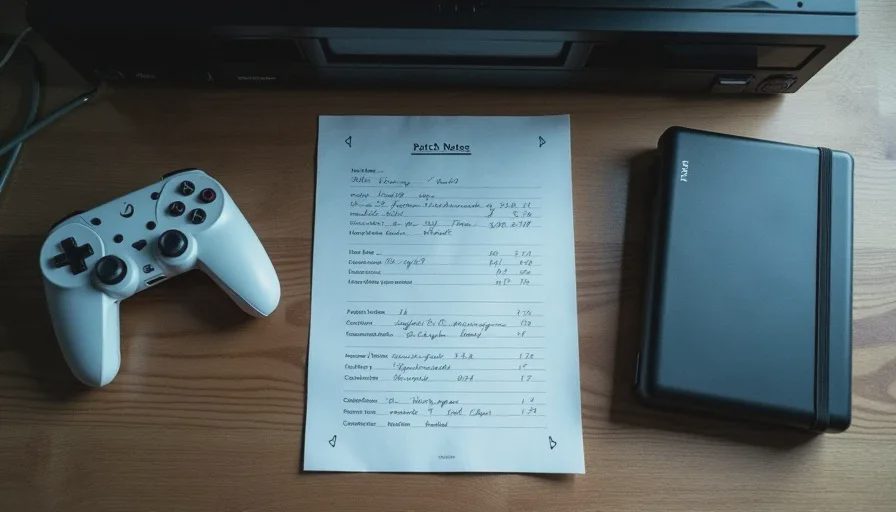
“Quality-of-life” is a phrase that arrives already framed as progress. It suggests the removal of unnecessary irritation. Faster menus. Auto-saves. Streamlined inventory. Cleared camera paths. Reduced backtracking. Modern control schemes mapped onto older systems. Each change can be defended in isolation. Taken together they often rewrite the original relationship between player and friction.
Sixth-generation games did not treat every inconvenience as a defect. Some of the resistance was deliberate. Some of it was the unavoidable result of hardware limits that designers then turned into structure. When later patches and remasters systematically remove that resistance, they do more than make the game easier to play. They alter the emotional and cognitive labor the game once required. The cost is rarely listed alongside the improvements.
I have spent enough time with both original versions and their updated counterparts to feel the shift in my own attention. The newer versions ask less of me in the moment. They also leave less residue afterward.

Friction as Information
An older inventory system with limited slots and deliberate management screens did not exist only to slow the player down. It made resource scarcity visible and continuous. Every pickup required a small decision. Every full inventory forced a judgment about what still mattered. The interface itself became part of the world’s pressure. Modern quality-of-life revisions usually expand the capacity, add quick-use shortcuts, or allow automatic management. The convenience is obvious. The constant low-level accounting disappears. Scarcity becomes an occasional scripted event rather than a persistent condition.
The same pattern appears in save systems. Manual save points, typewriters, limited ink ribbons, or stationary save rooms once created a rhythm of risk and relief. Reaching the next safe location was a measurable achievement. Auto-save and frequent checkpoints remove the possibility of significant loss. They also remove the heightened attention that accompanied the knowledge that the last twenty minutes could still vanish. Players report less frustration. They also report, less often, that the intervening sections feel more disposable.
Camera and movement changes follow a similar logic. Tank controls and fixed cameras were frequently replaced with free cameras and modern analog movement under the quality-of-life banner. The original schemes forced spatial awareness of a different kind. The player had to understand the room in relation to a locked viewpoint and a restricted turning radius. That understanding became part of the tension. The updated schemes reduce the learning cost and the occasional disorientation. They also flatten a layer of environmental resistance that had been designed into the experience.
The Cumulative Softening
Individual changes rarely destroy a game. The cumulative effect is more subtle. A remaster that smooths controls, expands inventory, adds auto-save, shortens forced walks, and clarifies objective markers can leave the core systems intact while transforming the overall temperature. The game becomes more generous with the player’s time and attention. In doing so it often becomes less demanding of the player’s presence.
I notice this most clearly in horror and survival titles from the period. The original versions treated the player’s cognitive load as a resource that could be taxed. Managing limited ammunition, limited inventory space, limited save opportunities, and limited visibility produced a continuous low-grade strain. That strain was not separate from the atmosphere; it was one of the primary ways the atmosphere was generated. Quality-of-life revisions tend to lower the baseline strain so that scripted scares and set pieces can stand out more cleanly. The baseline itself loses density.
There is a parallel in combat balancing. Many patches and remasters introduce options for assisted aiming, reduced enemy aggression, or more generous resource drops under the same heading of quality-of-life. These options are usually framed as accessibility. They succeed at that goal. They also make the original tuning—the precise relationship between scarcity, accuracy, and threat—optional rather than foundational. The game can still be played in a demanding way. The demanding way is no longer the default language of the design.
What Gets Measured and What Does Not
Patch notes and remaster feature lists are good at enumerating gains. They list the removed loading times, the added convenience features, the modernized controls. They almost never list the corresponding losses in attentional demand, in spatial uncertainty, or in the weight of small decisions. Those losses are harder to quantify and easier to dismiss as personal preference.
For an adult player whose free time is already limited, the calculation is more complicated than simple preference. A smoother version may allow more of the game to be seen in the available hours. It may also deliver a thinner experience per hour. The original friction, however inconvenient, often concentrated attention. The updated version distributes it more evenly and, in many cases, more thinly.
I am not arguing that every quality-of-life change should be reversed. Some original systems were simply clumsy rather than meaningful. The useful distinction is between friction that was incidental and friction that was structural. Structural friction shaped how the player thought, moved, and remembered. Removing it changes the game’s internal logic even when the story and the broad systems remain the same.
The phrase “quality-of-life” frames the discussion as if the only possible values are comfort and efficiency. Sixth-generation design sometimes operated under a different set of values: sustained tension, readable scarcity, and the deliberate use of inconvenience as a carrier of meaning. When those values are edited out in the name of improvement, the resulting game is easier to recommend to a wider audience. It is also, in a measurable number of cases, less itself.
The cost does not appear in the patch notes. It appears later, in the difference between a game that once felt like a continuous negotiation and a game that now feels like a more polished delivery system for the same content. The content survives. The negotiation is what quietly disappears.





No notes yet — write the first one.