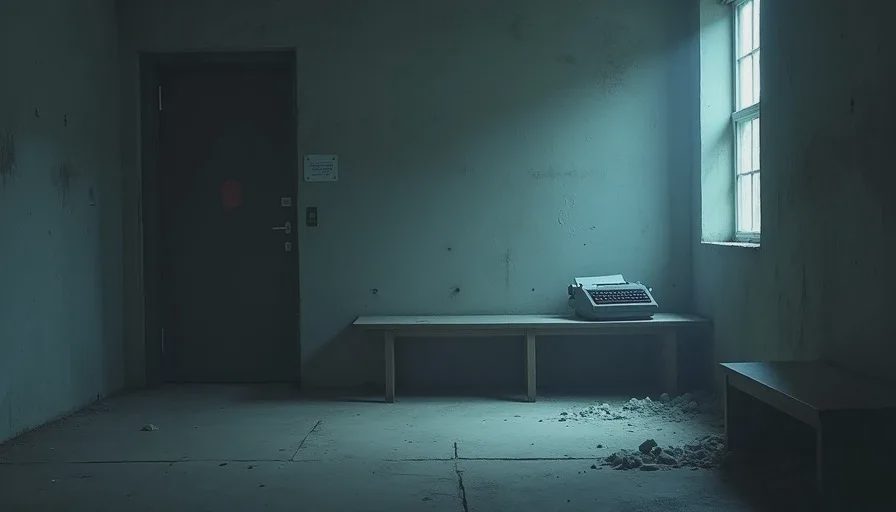
A save room in an older game was often little more than a bench, a light source, and a short ambient loop. Sometimes there was a typewriter or a simple notebook. Sometimes there was only the sound of the character’s breathing and the residual noise of the previous corridor. The space performed one primary function: it allowed the player to stop. Progress could be recorded. Tension could dissipate. The game briefly released its continuous claim on attention.
Modern hub worlds occupy the same structural position in the design and almost never permit the same release. They are filled with vendors, crafting stations, skill boards, side-quest givers, cosmetic options, and lore terminals. The space remains safe, yet it is never quiet. Recovery has been redesigned as a form of continued productivity. The player is still managing systems even while “resting.”
I trust the older rooms more. Not because they were more realistic or more immersive in a general sense, but because they understood that certain emotional registers require an interval in which the game stops asking for input. That interval has become rare.

Stillness as Functional Design
Sixth-generation hardware and production limits made sparse safe rooms a practical solution. There was rarely budget or memory for elaborate social hubs inside every campaign. Designers responded by creating small, repeatable spaces whose primary job was to mark the end of a pressure sequence and the beginning of a brief recovery. The visual language was often continuous with the rest of the world—same textures, same limited lighting, same muted palette—so that entering the room did not feel like leaving the game’s reality. It felt like finding a temporary pocket of lower intensity inside it.
The audio design reinforced the function. Ambient tracks were short and non-intrusive. There was little or no dialogue. The absence of new information allowed the previous sequence’s temperature to finish settling. Players could hear their own residual state. That hearing was part of the experience. The room did not overwrite it with fresh objectives.
Modern hubs invert the priority. Safety is still provided, yet the space is optimized for retention and system engagement. Every surface offers interaction. Every quiet corner is a potential menu. The player is given things to do while recovering so that downtime never becomes pure downtime. The design is coherent within a model that values continuous engagement. It is less coherent within a model that values the completion of an emotional cycle.
The Difference in Afterimage
I notice the distinction most clearly in the day-after memory of the space. Old save rooms remain distinct in recollection: the particular quality of the light, the exact length of the ambient loop, the feeling of having been allowed to stop. Modern hubs tend to blur together. They are more elaborate and less particular. Because they serve so many secondary functions, they rarely accumulate a single, coherent atmospheric signature. They are useful. They are harder to remember as places.

The same difference appears in the body during play. After a high-intensity sequence, an old save room produced a measurable drop in forward lean and shoulder tension. The game had signaled, through sparseness, that the claim on attention had been temporarily lifted. A modern hub rarely produces the same drop. The player remains in a low-level management posture—checking new items, scanning for uncompleted tasks, evaluating upgrades. The nervous system does not receive a clean signal that the pressure has ended. Recovery remains partial.
This is not an argument that every game should return to typewriters and empty benches. Some contemporary titles still protect sparse safe spaces and benefit from them. The broader trend, however, has been to treat any interval without systems engagement as wasted potential. The result is a catalog of hubs that are more feature-rich and less restorative.
What the Trust Is Based On
I trust the older rooms because they kept a clear boundary between pressure and recovery. That boundary allowed the residual feeling of the preceding section to remain audible long enough to become memory. When the boundary is filled with additional activity, the residual feeling is overwritten before it can settle. The game stays busier. The afterimage grows thinner.
For a player whose evening hours already have a hard outer edge, the distinction is practical. A space that permits genuine stillness returns more presence per minute than a space that converts stillness into another form of management. The older save rooms understood this without needing a theory of negative space. They were simply too limited to do anything else. The limitation produced a functional clarity that many larger, more capable hub designs have chosen to abandon.
The rooms themselves were never the point. The point was the interval they protected—the brief period in which the game stopped insisting and the player’s own residual state could still be heard. Modern hubs rarely protect that interval. They fill it. I continue to prefer the rooms that knew how to stay quiet. The silence was never empty. It was the medium in which the rest of the design finished its work.





No notes yet — write the first one.